Webasto Marine Air Conditioning: Self-Contained or Chiller?
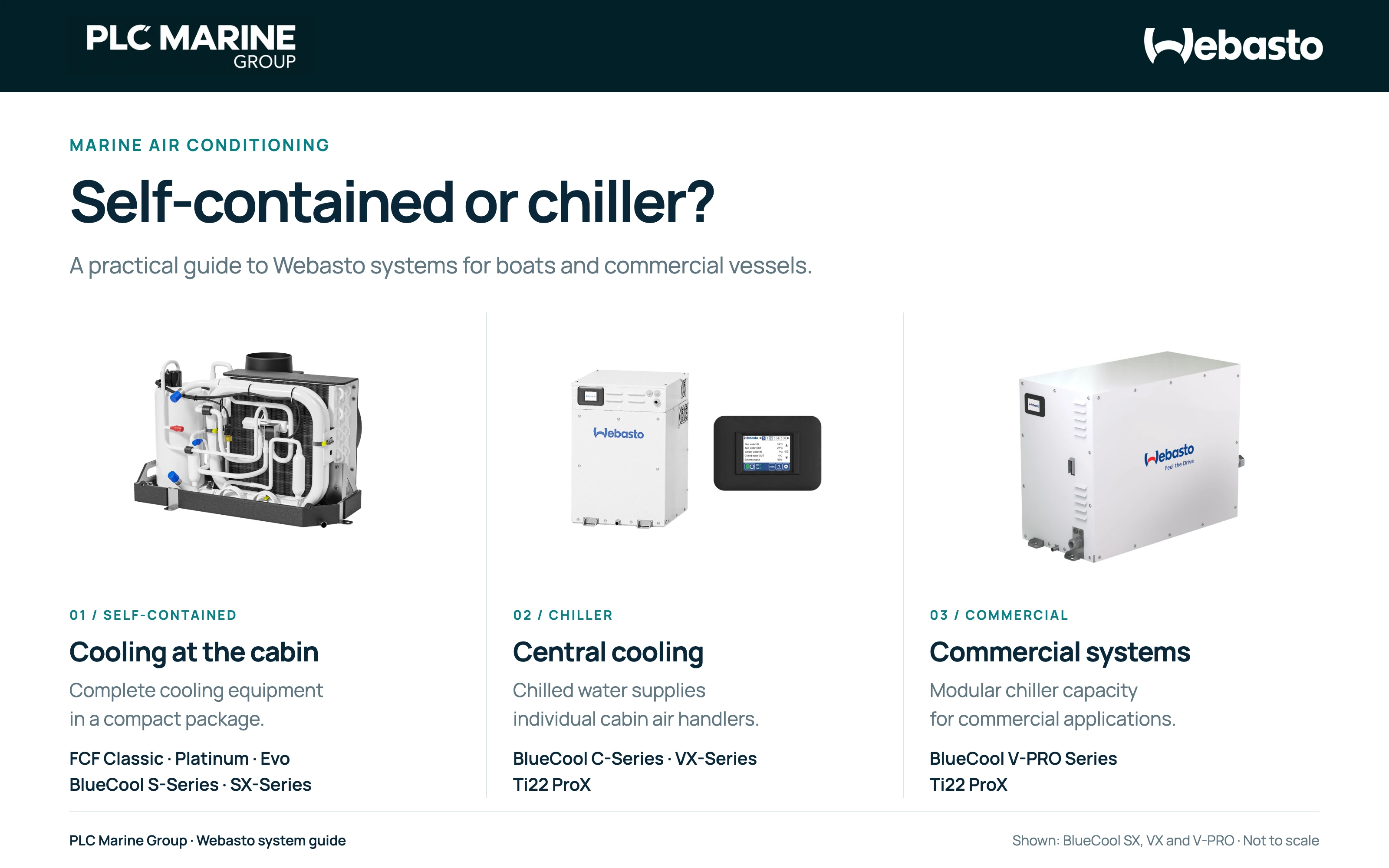
A practical guide to Webasto systems for boats and commercial vessels.
Choosing the right marine air-conditioning system starts with your boat’s layout, cooling requirements and how you use it. A compact cruiser with a few cabins has different needs from a larger yacht or a commercial vessel operating for long hours.
Webasto offers both self-contained units and central chilled-water (chiller) systems. The main difference is how each system delivers cooling to the cabins and other spaces on board.
How do the two systems work?
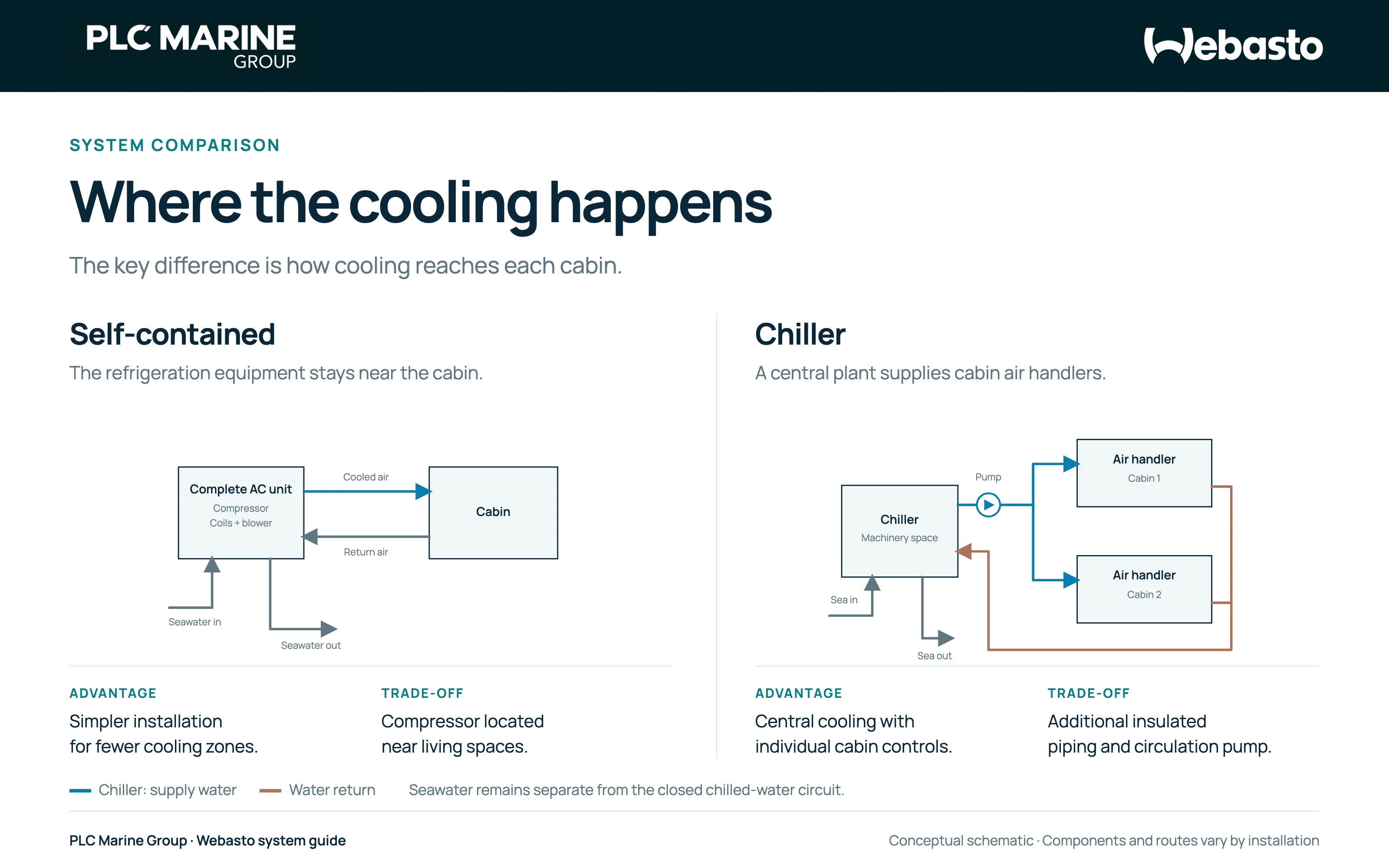
A self-contained system produces cooled air close to the cabin. The compressor, condenser, evaporator and blower are combined in one unit, usually installed beneath seating, inside cabinetry or in another suitable compartment. Ducting carries the cooled air into the accommodation.
A chiller system uses a central chilled-water plant. The refrigeration equipment is usually installed in a machinery space. A circulation pump moves chilled water through insulated piping to cabin air handlers, also called fan-coil units. Each air handler draws in cabin air, cools it across a coil and returns it to the accommodation.
The chiller’s chilled-water circuit is a closed loop, separate from the seawater circuit used to reject heat. Cabin air handlers still need adequate supply and return airflow, controls and condensate drainage. Webasto’s system component guide illustrates these separate circuits. For the seawater circuit, see our March pump selection guide; the required flow and installation conditions must be checked for the chosen equipment.
Self-contained systems: a practical choice for smaller boats
For suitable recreational boats up to 50 feet (15.2 m), PLC Marine generally recommends considering self-contained air conditioning first, particularly when only a small number of spaces need cooling.
The Webasto families covered in this guide are:
- FCF: Classic, Platinum and Evo.
- BlueCool: S-Series and SX-Series.
These names include earlier and newer product generations. Webasto has introduced FCF Evo as the successor to FCF Classic and Platinum, and BlueCool SX-Series as the successor to S-Series. Self-contained air conditioning therefore remains an actively developed part of the Webasto range. Webasto’s product transition announcement
Advantages
- Simpler installation for fewer cooling zones. The refrigeration components are packaged together, without a separate chilled-water distribution system.
- Typically lower initial cost for a small installation. Fewer cabins generally mean fewer units and less associated installation work.
- Useful for refits. A suitably sized unit can fit into an existing installation space, subject to checking dimensions, airflow, connections and electrical requirements.
- Local temperature control. Separate units can serve different areas according to their cooling needs.
Disadvantages
- The compressor is located near the accommodation. Mounting, vibration isolation and cabinet construction affect how much sound reaches the cabin.
- Equipment occupies space near living areas. Installation must allow room for return air, ducting, drainage and maintenance access.
- Several units create more installation points. As the number of cabins increases, multiple units and their associated connections can become less practical.
“Self-contained” describes the packaged refrigeration equipment. The water-cooled marine units discussed here still require seawater connections, electrical power, suitable airflow and condensate drainage.
Chiller systems: our recommendation for boats over 50 feet
For boats over 50 feet, PLC Marine recommends a chiller system. Central cooling is a practical approach when a vessel has several cabins, a large salon or multiple areas requiring individual temperature control.
A chiller can also be appropriate on a smaller boat with several cooling zones. Boat length provides a useful starting point, while the layout and calculated cooling load determine the final system.
Webasto chiller families covered in this guide include:
- BlueCool C-Series: Compact central chiller systems for boats with several cabins, including smaller and medium-sized vessels.
- BlueCool VX-Series: Modular chillers with variable-speed compressor control, allowing output to adjust to cooling demand.
- Ti22 ProX: Modular chillers for medium to large yachts and workboats, suitable for consideration in both new installations and replacement projects.
Advantages
- Centralized refrigeration equipment. Compressors can be located in a machinery space, reducing compressor noise near cabins when the installation is designed correctly.
- Individual cabin control. Air handlers distribute cooling to separate spaces, allowing different temperature settings.
- A practical arrangement for multiple zones. Insulated water pipes connect the central plant to air handlers throughout the vessel.
- Flexible capacity on suitable models. Modular arrangements and variable-speed technology can help match cooling output to changing demand.
Disadvantages
- Higher installation complexity. A chiller requires insulated water piping, circulation equipment, air handlers and careful commissioning.
- Typically higher initial cost. The additional equipment and installation work may be difficult to justify for a boat with only one or two small cooling zones.
- Shared components need careful planning. A circulation-pump or central-system fault can affect several cabins. Multiple chiller modules alone do not remove every shared point of failure.
- Additional components to maintain. Water flow, insulation, pumps, filters, air handlers and condensate drains all need attention.
A chiller is not automatically more economical to operate in every installation. Energy consumption depends on equipment selection, cooling load, operating conditions, pumps and how the system is controlled.
Commercial applications: Ti22 ProX and BlueCool V-PRO
Commercial vessels need a system selected around operating hours, occupancy, electrical supply and access for servicing.
Both Ti22 ProX and BlueCool V-PRO can be considered for commercial applications.
Ti22 ProX is designed for yachts and workboats. Its modular arrangement makes it relevant to projects requiring central cooling, including new builds and replacements where the existing installation must be assessed carefully. Webasto Ti22 ProX
BlueCool V-PRO offers modular, variable-speed cooling for yachts and commercial boats. Its independently controlled modules allow larger systems to be configured around the vessel’s cooling demand. Webasto BlueCool V-PRO
For either range, the final configuration should account for service access, maintenance arrangements and the level of cooling that must remain available if part of the system is out of service.
Which system suits your boat?
PLC Marine uses the following starting point when discussing marine air conditioning:
- Up to 50 feet: Self-contained systems are usually the first option to assess for boats with a limited number of cooling zones.
- Over 50 feet: We recommend a chiller system.
- Commercial vessels: Consider Ti22 ProX or BlueCool V-PRO according to the vessel’s requirements.
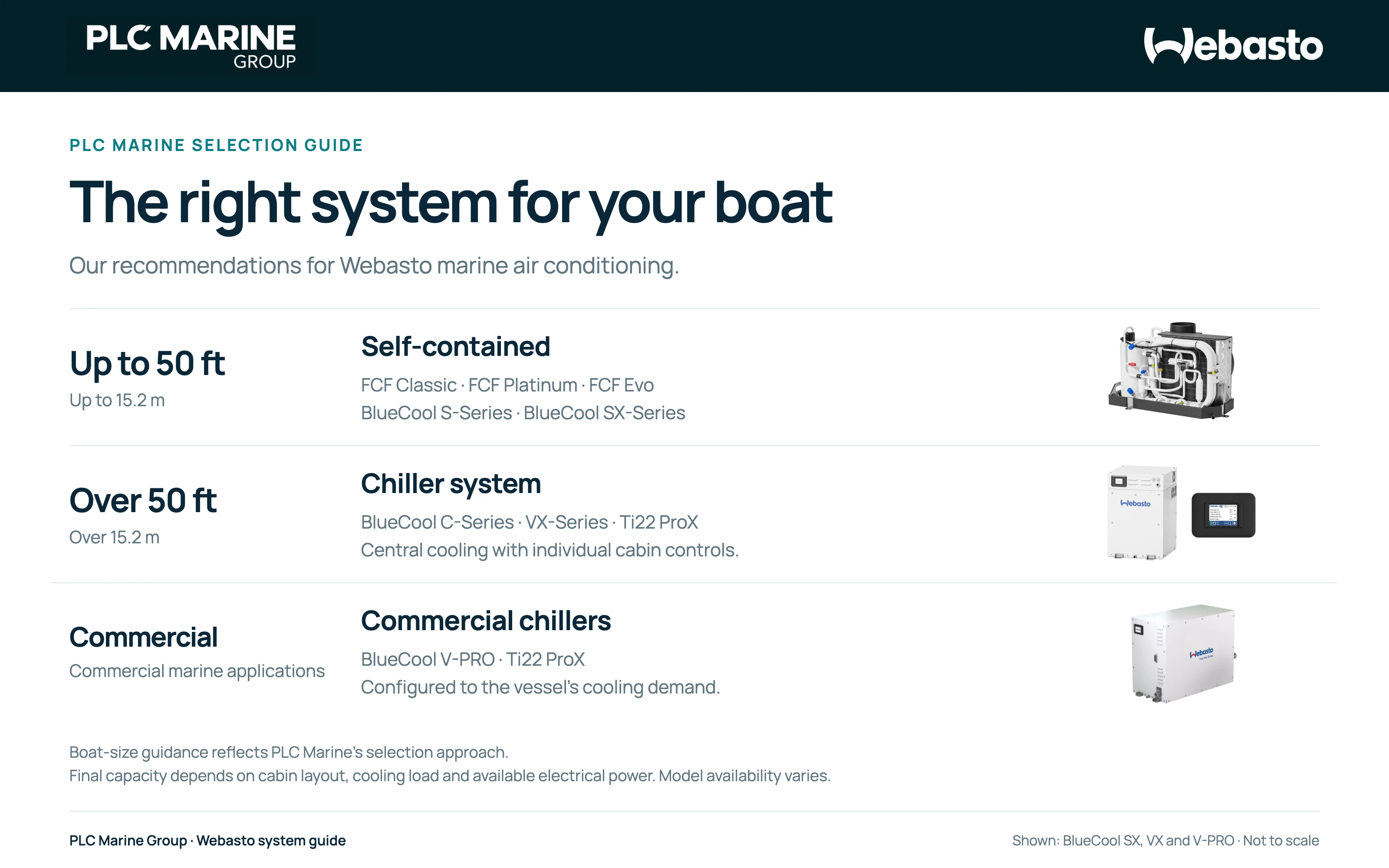
The 50-foot threshold is PLC Marine’s selection guidance. Final capacity must account for cabin volume, windows and sun exposure, insulation, passenger numbers, local climate and available electrical power. A smaller boat with several independent cooling zones may also benefit from a compact chiller.
This guide includes established and newer Webasto generations. Model availability and replacement compatibility should be confirmed for each project.
Find the right Webasto system with PLC Marine
Whether you are replacing an existing unit, upgrading a yacht or planning a commercial installation, start with a system that suits the vessel’s actual cooling requirements.
Contact PLC Marine to discuss your boat’s length, cabin layout, existing equipment and electrical supply, and identify the appropriate Webasto solution.